
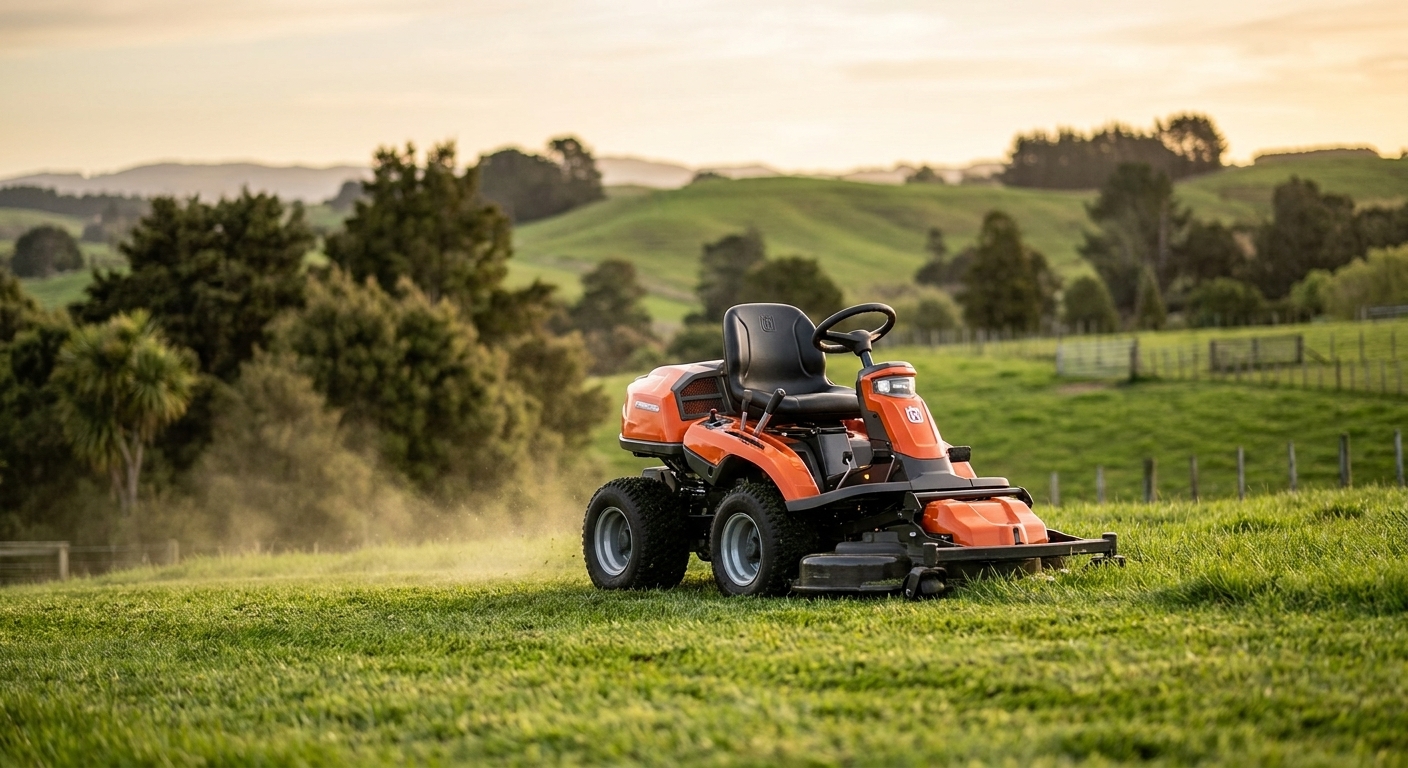
Choosing the best ride on mower for a New Zealand lifestyle block comes down to one question: how big is your grass and how much of it is flat. Get that wrong and you're either underpowered on a 2-hectare paddock or paying diesel money to mow a quarter-acre.
- Zero-turn ride-ons suit flat lifestyle blocks over 1 hectare — buy for speed and tight turns around trees.
- Lawn tractors from brands like Cub Cadet handle slopes and rough pasture better than zero-turns — consider for mixed terrain.
- Out-front deck mowers cut closer to fence lines and garden beds than side-discharge decks — buy if your block has lots of obstacles.
- Compact ride-ons suit blocks under 0.5 hectares — skip a full-size zero-turn here, it's overkill and costs more to run.
Why this matters
A ride-on mower is a multi-year purchase, not a weekend impulse buy. Get the wrong deck width or drivetrain for your terrain and you'll be fighting the machine every mowing session through 2026 and beyond.
Lifestyle blocks in New Zealand vary wildly — a flat 1-hectare paddock near Cambridge mows nothing like a sloped 3-hectare block outside Nelson. The best ride on mower NZ owners actually recommend depends on your ground, not the spec sheet alone.
How this list is ranked
This ranking weighs deck width against typical NZ lifestyle block sizes, drivetrain type against slope and obstacle density, and running cost against how often the machine actually gets used. It draws on the mower categories and brands stocked by The Mower Shed — including Ferris, Cub Cadet, Hustler and Stiga — matched against the terrain patterns common on NZ lifestyle blocks.
Each category gets a verdict based on the block size and terrain it suits best, not a generic "biggest is best" call. A machine that's brilliant on 2 flat hectares can be a liability on a steep half-acre with fruit trees.
The ranked picks
1. Zero-turn ride-ons (Hustler) — the speed pick
Zero-turn mowers pivot on the spot instead of making a three-point turn, which cuts mowing time dramatically on open ground. Deck widths on this style typically run 42 to 60 inches, letting you cover a hectare in well under an hour on flat pasture.
They're built for speed and tight manoeuvring around isolated trees, not for climbing steep banks — the low centre of gravity that makes them nimble also makes them less stable on slopes over roughly 15 degrees. On a flat-to-gently-rolling lifestyle block over 1 hectare, a Hustler zero-turn is the fastest way to get the job done. Buy if your block is mostly flat and open.
2. Lawn tractors (Cub Cadet) — the all-rounder
Lawn tractors use a steering wheel and a longer wheelbase, which gives more stability on slopes and rougher ground than a zero-turn. They're slower to turn but far more forgiving on uneven pasture, dips, and wet grass that would spin a zero-turn's rear wheels.
They also tend to have more towing and attachment capacity — useful on a working lifestyle block where the mower doubles as a light trailer-puller. If your block mixes flat lawn with sloped or rough paddock, a Cub Cadet lawn tractor is the sensible middle ground. Buy for mixed terrain; Consider if you're purely flat and want maximum speed instead.
3. Out-front deck mowers (Ferris) — the precision pick
Out-front deck mowers position the cutting deck ahead of the operator rather than underneath, which gives a clear sightline to the deck edge. That matters when you're trimming close to fence lines, garden beds, or scattered trees — obstacles that eat time on a standard mid-mount deck.
The trade-off is a slightly larger turning footprint than a true zero-turn in tight corners. For a lifestyle block with orchard rows, garden borders, or a driveway lined with obstacles, the visibility advantage of a Ferris out-front deck outweighs the extra manoeuvring space it needs. Buy if your block has heavy obstacle density; Skip if your ground is wide open with nothing to trim around.
4. Compact ride-ons (Stiga) — the small-block pick
Compact ride-ons scale everything down — narrower deck, smaller engine, tighter footprint — for blocks where a full-size zero-turn or lawn tractor is genuinely too much machine. They're easier to store, cheaper to run, and still faster than pushing a walk-behind across a quarter-acre to half-hectare section.
Buying a full 60-inch zero-turn for a 0.4-hectare block means paying more up front and more in fuel for capacity you'll never use. A Stiga compact ride-on matches the job size instead. Buy for blocks under roughly 0.5 hectares; Skip if you've got open pasture over a hectare — you'll outgrow it fast.
“If your block is under half a hectare, a zero-turn is overkill — buy a compact ride-on instead.”
Comparison table
| Type | Best block size | Typical deck width | Terrain fit | Verdict |
|---|---|---|---|---|
| Zero-turn (Hustler) | 1+ hectare, flat | 42-60 inch | Flat, open | Buy |
| Lawn tractor (Cub Cadet) | Mixed size, rolling | 42-54 inch | Slopes, rough pasture | Buy |
| Out-front deck (Ferris) | Any size, obstacle-heavy | 48-61 inch | Fences, trees, beds | Buy |
| Compact ride-on (Stiga) | Under 0.5 hectare | 24-36 inch | Small flat sections | Buy |
Where to buy
- Match the deck to the block, not the budget. Buying oversized capacity you don't need costs more in fuel and servicing every season through 2026 and after.
- Check parts and service support before you commit. A ride-on with no local parts backup for a Ferris or Cub Cadet deck or engine turns a small repair into weeks of downtime.
- Ask about attachments up front. If you'll eventually want a mulching kit, catcher, or trailer hitch, confirm it's available for the specific model before buying, not after.
FAQ
What is the best ride on mower for a NZ lifestyle block?
For flat blocks over 1 hectare, a zero-turn like a Hustler wins on speed. For sloped or mixed terrain, a Cub Cadet lawn tractor handles the ground better than a zero-turn.
Is a zero-turn or lawn tractor better for a sloped lifestyle block?
A lawn tractor is better on slopes. Zero-turns have a lower centre of gravity and less stability once the ground pitches past roughly 15 degrees.
How big does a lifestyle block need to be to justify a ride-on mower?
Most owners find a ride-on pays off once a section passes 0.3 to 0.5 hectares. Below that, a compact ride-on or a quality push mower is usually enough.
What deck width do I need for a 1-hectare block?
A 42 to 60 inch deck is standard for 1-hectare blocks in 2026, with the wider end suited to flatter, more open ground.
Do out-front deck mowers cut closer to fences than zero-turns?
Yes. The deck sits ahead of the operator with a clear sightline, which makes trimming along fence lines and garden beds easier than with a mid-mount deck.
Are compact ride-ons worth it for small sections?
Yes, for blocks under about 0.5 hectares. A full-size zero-turn on a small section means paying more upfront and in fuel for capacity you won't use.
How much does terrain affect which ride-on mower to buy?
Terrain matters more than block size alone. A steep 0.6-hectare block often needs a lawn tractor's stability over a zero-turn's speed advantage.
What brands of ride-on mower are common in NZ lifestyle blocks?
Ferris, Cub Cadet, Hustler and Stiga are common ride-on brands sold in NZ, each suited to a different mix of block size, terrain and obstacle density.
One last thing
The single biggest mismatch on NZ lifestyle blocks isn't brand — it's buying deck width for the block you wish you had instead of the one you're mowing today. A 60-inch zero-turn on a broken, obstacle-heavy 0.7-hectare section spends more time backing up around trees than it saves in raw cutting speed.
Walk your own block before you shop. Count the trees, note the slope, measure the flat run — then match the mower category to that, not to the biggest deck on the lot.
The range at The Mower Shed covers all four categories above, so the right call is picking the type that fits your ground, not choosing between brands first.